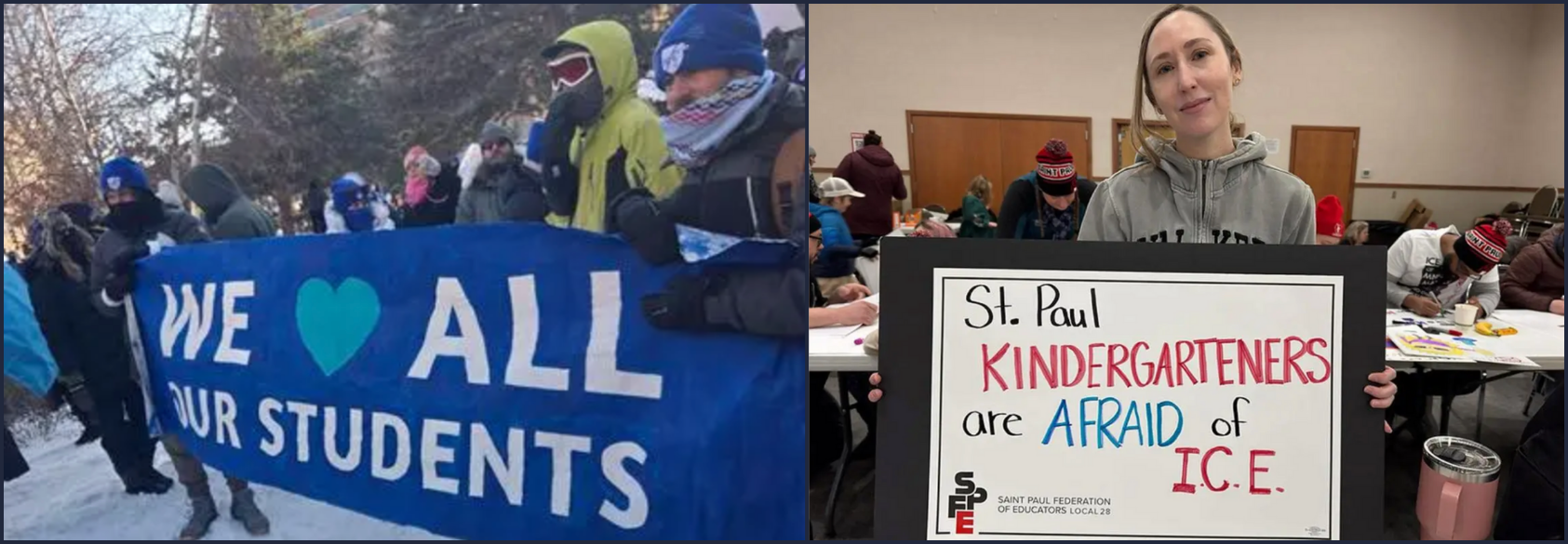
“I’m constantly on alert” for incursions by ICE, she said. “They’re creeping, and they’re creeping, and they’re creeping. They are supposed to have a judicial warrant, but they haven’t been playing by the rules for weeks now.” That said, VanDassor asserted that if everyone stands up for their rights, no matter where they live, “that’s what ICE did not count on.”
What the Public Is Saying
A New York Times/Siena poll released Jan. 23 found 61 percent of voters saying the tactics ICE uses have “gone too far.” That included over 9 in 10 Democrats, about 7 in 10 Independents and roughly 2 in 10 Republicans. Just 26 percent of voters overall said ICE’s tactics were “about right.”
According to a Jan. 23-26 YouGov/Economist poll, a growing share of Americans lacks confidence in ICE. More of them support cuts to ICE spending than to any of nine other types of federal spending they were asked about. Fifty-five percent say they have very little confidence in ICE, an increase of 10 percentage points since mid-December. Confidence in ICE has declined most among Independents: 67 percent now say they have very little confidence in ICE, up from 49 percent in December. Three-quarters of respondents started the survey after Pretti’s killing.
The unrest is not just in Minnesota, either. It’s occurring in Maine, Arizona, California, Illinois and elsewhere. AFT members where ICE operations are underway include:
- Employees at a Minneapolis high school where ICE used tear gas as students were dismissed;
- A teacher in a nearby suburb who reported that ICE apprehended two students at their after-school jobs;
- Teachers in Detroit pressing for the release of students held in detention centers; and
- Nurses in Oregon concerned about ICE while detainees receive medical treatment.
The AFT is calling for ICE to stay out of schools, preschools and hospitals. This is a moral moment as Americans state that schools and communities must be safe and welcoming places, not targets of violence.
Other webinar panelists (short video clips here) included Roman Palomares, national president of LULAC, the nation’s oldest and largest Latino organization. In Los Angeles, he said, schools have suffered a 24 percent drop in enrollment. That’s about 16,000 kids.
Palomares commended the courage of school employees. “Educators are not bystanders,” he said. “You all are the frontline defenders of stability.”
Sarina Roher, president of OFNHP, reminded everyone of the responsibility of healthcare workers. Our duty of care extends beyond the individual patient to the conditions that shape whether care is even possible. When fear enters healthcare spaces, she added, when armed law enforcement is present during care, when patients hesitate or delay seeking treatment, the standard of care is compromised for everyone.
On a related point, Lindsey Sadlou, a statewide political organizer for the Oregon AFL-CIO, described how unions took part in an October training in nonviolent resistance. She endorsed the idea that it will take 5 percent of the U.S. population rising in protest to rid our communities of ICE.
Andrea Vásquez is secretary of the Professional Staff Congress in New York City, an AFT affiliate representing 30,000 faculty and staff at the City University of New York. She shared their immigration solidarity work to help students and employees on and off campus respond to the federal government’s targeting of immigrants. Vásquez recounted how, after ICE showed up during a job fair at the John Jay College of Criminal Justice, students organized and ICE did not return. Then in May, ICE started seizing immigrants at the courts, so more than 200 PSC members trained to become court watchers—and most were not experienced activists.
“It is our legal right to bear witness,” Vásquez said. “We will not give up that space. We will always fight for our students.”
Daniel Coates, public affairs director of Make the Road New York, emphasized the importance of action. He said his group is training hundreds of protesters every week. Having a plan, even a whistle for alerting your neighbors to the presence of ICE, is powerful as “neighborism” becomes a political philosophy.
Weingarten agreed. The AFT will be part of the next No Kings rallies on March 28, she said, as well as an action with Sunrise on March 4.
Jonathan Blazer,senior policy counsel for the American Civil Liberties Union, offered a rundown of our rights and what we should do if apprehended, including remaining calm, avoiding sudden movements, keeping hands visible, following orders or asking for clarification, and asking if we are free to go.
“ICE must abide by the Constitution,” Weingarten added. “It pretends it doesn’t have to, but it must.”
Keeping Up the Good Work
States’ reactions to the ICE killings vary widely. In Tennessee, according to the New York Times, a proposal would force the government to verify the immigration status of schoolchildren, despite a decades-old Supreme Court ruling that schools cannot do that. In Maryland, proposed legislation called the “ICE Breaker Act of 2026” was introduced in the General Assembly. The bill would keep recent ICE officers out of state law enforcement jobs.
In the wider culture, commentators from songwriter Bruce Springteen to Minnesota sportswriter Jim Souhan are lifting up the moral imperative of safeguarding peaceful protest and other liberties guaranteed by the First, Second and Fourth amendments to the Constitution.
AFT Executive Vice President Evelyn DeJesus closed the webinar with a call to action. “Our beloved country is at risk,” she said. “Our most cherished rights are under assault.” She exhorted members to meet ICE’s guns with nonviolence and to turn the tide of hate.
Our members are taking action in many ways. A first step is using the resources above. A second is telling your representatives in Congress to Keep ICE Out.
Republished with permission from AFT.